
Most people buy life insurance to protect their own income. A permanent policy bought for a child works differently — it protects three generations at once, and each one can actually use it in a different way: the parents or grandparents who start it, the child who inherits it as an adult, and the grandchildren who eventually benefit from it.
How It Works, Generation By Generation
Generation One — the parents or grandparents who start the plan. They fund the policy and hold access to its cash value while the child is growing up. That cash value can be drawn on to help fund the child’s education, to help cover costs if the child ever faces a critical illness, or — since it’s their asset until it transfers — to supplement their own retirement income or help pay for long-term care later in life. A small permanent policy on a newborn is inexpensive by design: a healthy infant is about the lowest-risk person an insurer will ever underwrite, and the policy quietly locks in insurability before a childhood diagnosis could take it away. About 1,000 Canadian children are diagnosed with cancer each year, and Type 1 diabetes diagnoses are rising roughly 3% annually — either can make adult coverage difficult to get later.
Generation Two — the child, once grown, as the insured and new owner. When ownership transfers, the adult child steps into a permanent policy with decades of tax-deferred growth already behind it (under the CRA’s exempt-policy rules), often partially or fully paid up, plus — with many riders — the right to add more coverage later regardless of their own health. They can use the cash value for a home down payment or a business, or simply keep the protection through their own working years.
Generation Three — their kids, who inherit the death benefit. When the second generation eventually passes, the policy’s death benefit pays out to their beneficiaries tax-free — often used to help cover the capital gains tax triggered on the rest of the estate, so a cottage, investments, or other assets don’t have to be sold in a hurry just to pay that tax bill.
Beneva: What Built-In Protection Can Look Like
Beneva, one of Canada’s largest mutual insurers, is a useful example of how a policy can carry extra protection at no added cost. Most of its permanent policies include an Extreme Disability Benefit — up to 50% of the coverage (to a maximum of $250,000) paid in advance if the insured faces extreme disability for six months before age 60. Its child rider adds an Automatic Newborn Benefit, covering a new baby from about 15 days after birth with no extra premium, plus optional critical illness coverage for a defined list of childhood illnesses. Not every insurer bundles protection this way — it’s worth comparing.
Why Permanent, And Sometimes Universal
Term insurance suits a specific need over a specific number of years; it isn’t built to be handed down. Permanent insurance is. Whole life grows cash value at a rate the insurer sets. Universal life splits the premium into an insurance cost and a separate investment account you help choose — daily interest, index-linked, or fund-based — that grows tax-deferred the same way. For a policy with 60-plus years to compound, that choice can matter.
A Worked Example: The Chen Family
This is an illustrative example for education, not an actual client case.
When Mia was born, her grandmother funded a $50,000, 20-pay whole life policy for roughly $40 a month. Twenty years of premiums total about $9,600 — but tax-deferred compounding means the policy’s value doesn’t stop there:
| Mia’s age | Illustrative cash value |
|---|
| 0 (policy starts) | $0 |
| 20 (premiums finished) | ~$11,000 |
| 40 | ~$28,000 |
| 65 | ~$72,000 |
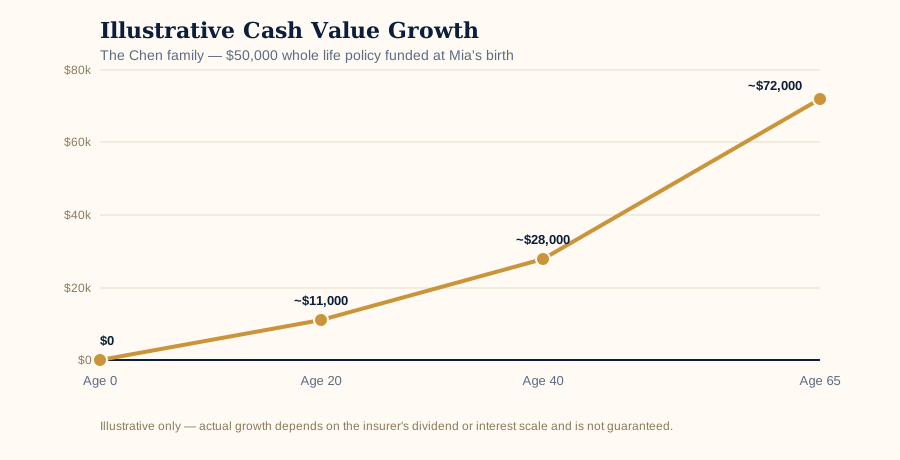
By the time Mia is deciding whether to use the policy for a down payment or simply keep it, her grandmother’s original $9,600 has done decades of quiet compounding. These figures are illustrative only — actual growth depends on the insurer’s dividend or interest scale and is never guaranteed.
A Second Example: Universal Life With Overfunding — The Osei Family
This is an illustrative example for education, not an actual client case or policy illustration.
When their son Kwame turned one, the Oseis set up a Beneva Universal Life policy on him with a $200,000 death benefit, paying $200 a month. The policy includes the Extreme Disability Benefit at no extra cost, plus a children’s critical illness rider. Together, the cost of insurance and the rider run roughly $50 a month — leaving about $150 a month to “overfund” the policy’s investment account, beyond the minimum needed to keep the coverage in force.
That extra $150 a month grows inside the policy’s tax-deferred account. Assuming an illustrative 5%–6% average annual return — one of several investment options available inside a Beneva UL policy — the account could look roughly like this:
| Kwame’s age | Illustrative cash value (5%–6% growth) |
|---|
| 1 (policy starts) | $0 |
| 10 | ~$20,000 |
| 20 | ~$55,000–$61,000 |
| 30 | ~$112,000–$133,000 |
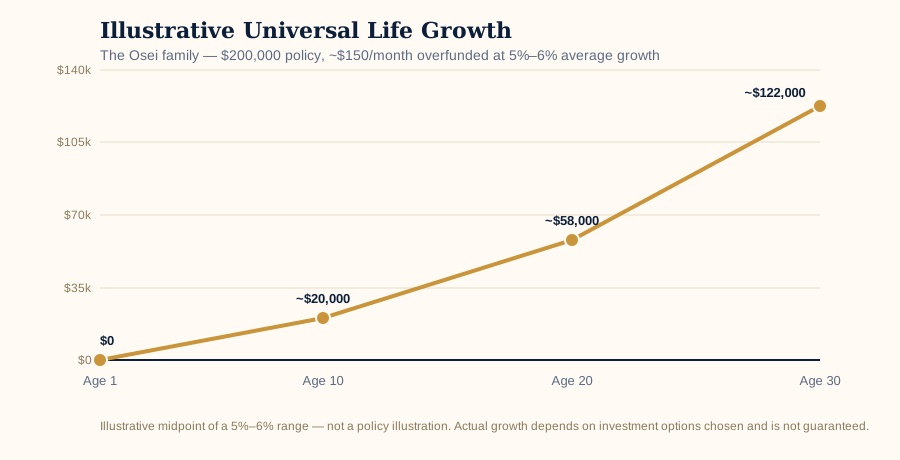
None of this changes the $200,000 death benefit the family is protecting — it’s a separate account building alongside it. As with any universal life policy, actual growth depends on the investment options chosen, the insurer’s charges, and market performance, and is never guaranteed.
What This Means For Your Plan
This isn’t a strategy for every family, and it isn’t a substitute for making sure your own protection comes first — see why life insurance matters and our Life Insurance page. If the basics are covered and you’re weighing whether a child policy fits, or which insurer’s built-in features actually matter, that’s exactly the kind of question a 30-minute session is built for.
This article is for general education only and is not personalized financial, investment, insurance, or tax advice. Insurance coverage, eligibility, premiums, riders, and policy terms depend on the insurer, product, underwriting, and your individual circumstances. Illustrative figures are not guaranteed. Tax treatment of cash-value life insurance depends on your specific policy and current CRA rules — speak with a qualified advisor before making insurance or tax decisions.
Want to talk through this?
Start with a 30-minute session or protection review. No guaranteed outcomes are promised; the goal is to understand your situation and possible next steps.
Book a 30-Minute Session Related: Explore our financial planning services