Most people don’t get into debt trouble by making one bad decision — they get stuck by making an ordinary decision (carry a balance for a few months) inside a system that’s quietly built to keep that balance alive. Understanding how interest and minimum payments actually work is the first step to getting out. Choosing the right payoff method is the second.
The Current Picture
A few numbers worth sitting with:
- Canadian household debt hit a record 179.6% of disposable income in Q1 2026 — roughly $1.80 owed for every dollar of after-tax income, and the sixth straight quarterly increase.
- The average debt service ratio — the share of income going toward debt payments — edged up to 14.75%.
- The average credit card interest rate in Canada runs 19.99%–23.99%, with some cards reaching 25%.
- Canada’s prime rate sits at 4.45%, holding steady alongside the Bank of Canada’s policy rate of 2.25% — which still leaves variable lines of credit meaningfully more expensive than they were a few years ago.
- Among Canadians carrying non-mortgage debt, the average balance is about $24,800; average credit card balances run in the $4,500–$4,700 range.
None of this means debt itself is the problem — a mortgage, a car loan, or a line of credit used deliberately is just a financial tool. The problem is high-interest, revolving debt: the kind that compounds every month whether or not you’re paying attention to it.
Why “Bad” Debt Stays Bad
Two mechanics work against you at the same time.
Interest compounds daily on most revolving debt. A credit card charging 20.5% doesn’t just take 20.5% of your balance once a year — it accrues daily, so every day you carry a balance, a little more interest gets added to what you owe next month.
Minimum payments are designed to barely dent the principal. Most Canadian card issuers calculate minimum payments as roughly 2–3% of the balance (or a small flat amount, whichever is higher). Here’s what that looks like on a $5,000 balance at 20.5% interest, paying only the minimum:
- Most of each early payment goes to interest, not principal
- The balance shrinks so slowly that it can take 20+ years to pay off
- Total interest paid can end up higher than the original balance itself
That’s the trap: minimum payments aren’t designed to get you out of debt quickly — they’re designed to keep the balance technically “in good standing” while interest keeps compounding underneath. The only way to break that pattern is to consistently pay more than the minimum, with a plan for where the extra money goes.
Two Ways Out: Snowball vs. Avalanche
Once you’ve committed to paying more than the minimum across multiple debts, there are two well-tested ways to decide where that extra money goes first.
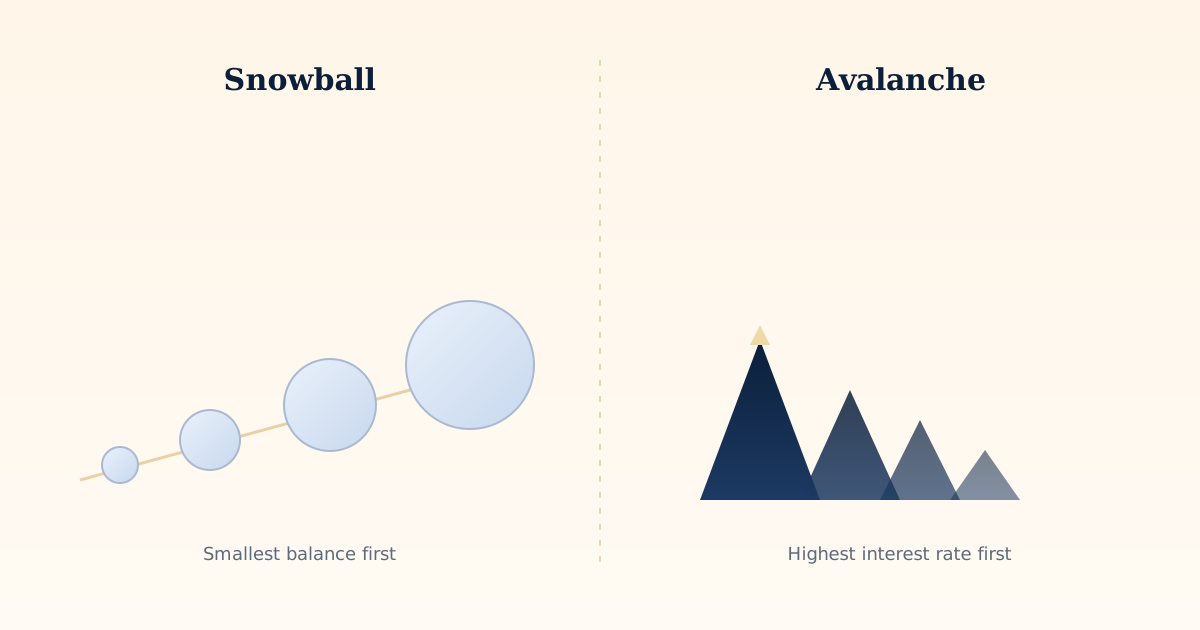
The Snowball Method: List your debts smallest balance to largest, ignoring interest rate. Put every extra dollar toward the smallest balance while paying minimums on everything else. Once it’s gone, roll that entire payment into the next-smallest balance, and so on — the “snowball” gets bigger each time a debt disappears.
- Strength: Fast, visible wins. Clearing a whole debt in month two or three builds real momentum and proof that the plan is working.
- Trade-off: If your smallest balance isn’t your highest-interest debt, you’ll pay somewhat more in total interest over time than the mathematically optimal path.
The Avalanche Method: List your debts highest interest rate to lowest, ignoring balance size. Put every extra dollar toward the highest-rate debt while paying minimums on everything else. Once it’s gone, move to the next-highest rate.
- Strength: Minimizes total interest paid — mathematically the cheapest way out of multi-debt situations.
- Trade-off: If your highest-rate debt also has a large balance, it can take a long time to see a debt fully disappear, which is harder to stay motivated through.
How to Choose Between Them
There’s no universally “correct” answer — the right method depends on you, not just the math.
- If you’ve started and stopped debt payoff plans before, the snowball’s early wins are often worth more than the extra interest saved by the avalanche — a plan you stick with beats a theoretically optimal plan you abandon in month four.
- If your interest rates vary a lot (say, a 25% store card next to a 9% line of credit), the avalanche saves meaningfully more money, because so much more of every dollar is going to interest on the expensive debt.
- If your balances and rates are fairly similar across debts, the choice matters less — pick whichever keeps you engaged, since the two methods end up close in total cost.
- A hybrid approach is common in practice: use the avalanche for anything charging a notably higher rate than the rest, then switch to snowball logic among what’s left for motivation.
Three Scenarios
These are simplified, illustrative examples only — not a projection of what will happen with your own debt, which depends on exact rates, fees, and payment timing.
Scenario 1 — Three cards, similar balances. $2,000 at 22%, $2,500 at 19%, $2,200 at 24%. Balances are close enough that snowball and avalanche finish within a month or two of each other — go with snowball for the quicker first win (the $2,000 card clears first).
Scenario 2 — One high-rate card, one large low-rate line of credit. $3,000 credit card at 21%, $15,000 line of credit at 8%. Avalanche wins clearly here: the card is both smaller and far more expensive, so it should be the priority under either method — but avalanche formalizes that the line of credit’s low rate means it’s not urgent, freeing up more money for the card sooner.
Scenario 3 — Several small debts plus one large one. $800, $1,200, $1,600, and a $9,000 balance, rates all in the 18–22% range. With rates this close together, snowball is attractive — three of the four debts can likely be cleared within the first year, which matters more for staying motivated than the modest interest difference.
The Real Point
The method you choose matters less than actually choosing one and sticking with it. Whichever path you pick, the mechanics are the same: pay more than the minimum, direct the extra deliberately instead of spreading it evenly, and reassess as balances close out. If you’re not sure where your own debts fit into this, or whether restructuring (consolidation, a lower-rate line of credit, refinancing) makes more sense than either method alone, that’s exactly what a cash flow and debt review is for.
Want to run your own numbers? Try the free Debt Payoff Calculator, which compares an avalanche payoff order across up to three debts and estimates the timeline.
This article is for general education only and is not personalized financial, investment, insurance, or tax advice. Interest rates, minimum payment calculations, and loan terms vary by lender and product, and change over time — speak with a qualified advisor before making debt repayment decisions.
Want to talk through this?
Start with a 30-minute session or protection review. No guaranteed outcomes are promised; the goal is to understand your situation and possible next steps.
Book a 30-Minute Session Related: Explore our financial planning services