There’s an old saying in family business circles: shirtsleeves to shirtsleeves in three generations. The first generation builds the wealth. The second maintains it. The third — having never known what it took to build — squanders it. It sounds harsh. It’s also close to the statistical average, and almost nobody plans for it on purpose.
What A “Family Business” Actually Is
A family business is any company where a family controls ownership, holds real influence over decisions, and — usually — expects that control to eventually pass to the next generation. That covers everything from a two-person shop to a $50-million manufacturer. In Canada, family firms make up roughly 63% of all private-sector businesses, and together they generate close to half of private-sector GDP and half of private-sector employment. This isn’t a niche topic. It’s most of the Canadian economy, run by people who mostly haven’t written down what happens next.
The Number That Should Worry Every Family Business Owner
Here’s the uncomfortable part: only about 30% of family businesses survive into the second generation. Just 12% make it to the third, and a mere 3% reach a fourth generation or beyond. The businesses that do beat those odds tend to share a few specific things — documented governance, clear economic rights for family members whether or not they work in the business, a real plan for developing the next leader, and an ownership structure built with tax efficiency in mind from the start. Meanwhile, roughly two-thirds of Canadian family enterprises have no formal succession plan at all, despite knowing exactly how much is riding on it.
That gap — between how much value is at stake and how little planning actually happens — is where families lose more than money. They lose relationships, careers, and sometimes each other.
Why This Is So Hard: The Three Circle Model
In 1978, Harvard Business School researchers Renato Tagiuri and John Davis published a framework that’s still the clearest way to understand why family businesses are so difficult to run smoothly. It’s called the Three Circle Model, and it maps a family enterprise as three overlapping circles: Family, Ownership, and Business.
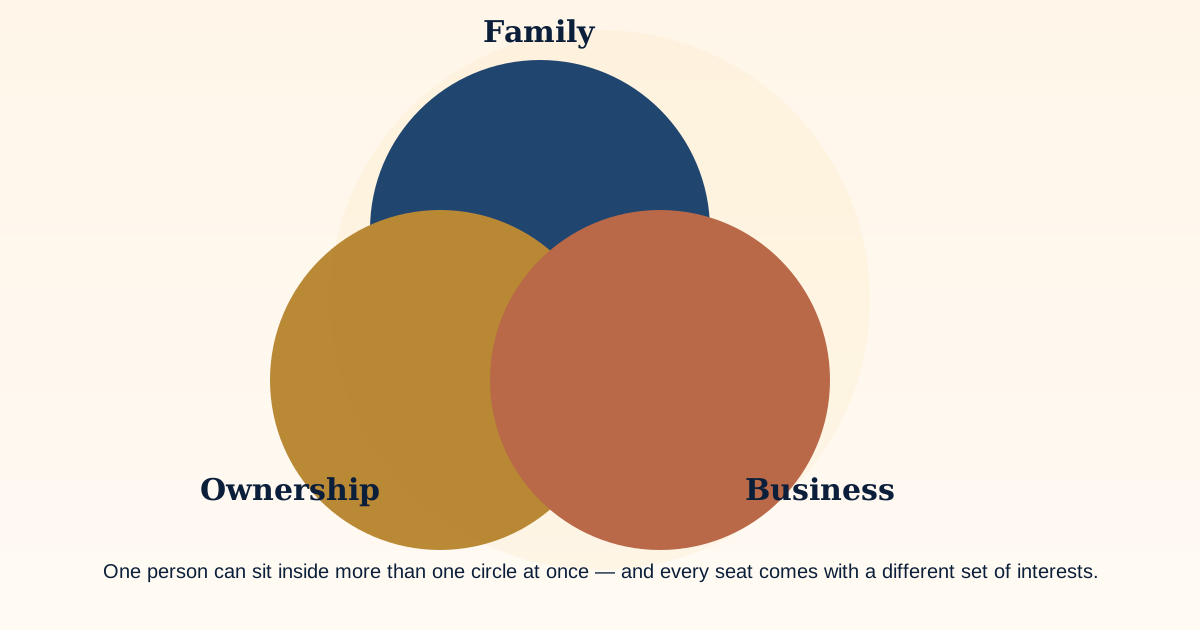
Everyone connected to the company sits somewhere in that diagram — and the overlaps are where the tension lives. A founder often sits in all three circles at once: family member, owner, and operator. An adult child working in the business but holding no shares yet sits in Family and Business, but not Ownership. A sibling who never joined the company but inherited shares sits in Family and Ownership, but not Business. A professional, non-family CEO sits in Business alone.
The reason family business conflict feels so personal is that people are constantly switching circles without announcing it. A father giving his daughter operational feedback at 2 p.m. is speaking from the Business circle. The same conversation at Sunday dinner is happening in the Family circle — but it can feel like the same conversation to both people, with none of the same rules. Most succession conflict isn’t really a disagreement about money. It’s two people standing in different circles, each certain they’re having the same conversation.
Meet The Grewals: A Case Study
This is an illustrative example for education, not an actual client case.
Ranjit and Simran Grewal founded Grewal Family Foods 25 years ago — a wholesale food distribution business that’s grown into their family’s most valuable asset, worth roughly $9.5 million today. They have four adult children:
- Priya (29) has spent seven years in the business, working her way through nearly every department. She’s the one employees naturally go to with problems.
- Aman (31) is a CPA who has managed the company’s finances for the past five years and understands its numbers better than anyone outside the accounting firm.
- Divya (26) is a family physician with a demanding practice of her own. She’s never worked at the company and has no interest in running it.
- Karan (23) teaches high school. He grew up around the business but has always been clear it isn’t the life he wants.
Ranjit and Simran are close to retirement and want three things: fairness to all four kids, continued growth of the business, and a decision the whole family can actually live with — not just the two who happen to work there.
Their first instinct, like a lot of parents, was to think about splitting everything evenly. But Priya and Aman have spent years building equity — in effort, if not yet in shares — that Divya and Karan haven’t. Divide the company four ways and you can hand voting control to two people who have never set foot in the warehouse, while the two who’ve run it for years answer to siblings who don’t understand the business. That’s not equal. It’s just even, which isn’t the same thing.
The Five Paths Forward
Every family business eventually faces some version of this choice. None of these options is universally right — each trades something away.
1. Sell to an outside buyer.
Pros: Maximizes after-tax proceeds in a clean transaction, with no risk of a messy internal transition and less chance of family conflict.
Cons: The business — and the family’s legacy in it — leaves the family for good. Priya and Aman lose the company they’ve been building their careers around. It’s also a decision that often runs against a founder’s actual values, even when it makes the cleanest financial sense.
2. Split the shares equally among all the children.
Pros: It’s the simplest option on paper, and it feels fair on the surface.
Cons: An outright distribution can trigger tax immediately, hands equal voting power to people with very different levels of involvement, and creates a structural mismatch — the siblings actually running the business now answer to two shareholders who don’t work there and may want different things from it. It can also leave the parents’ own retirement funding tied up in a business they no longer control.
3. Sell the business, at fair value, to the children already working in it.
Pros: Priya and Aman recognize the opportunity and are willing to make both the financial and personal commitment it requires. Since 2021, changes to the Income Tax Act (more on that below) have made this kind of intergenerational sale far more tax-competitive than it used to be. It’s also a strong filter for who’s genuinely motivated to take the business forward.
Cons: A sale at fair value rarely delivers what the parents would get from an outside buyer, usually requires the parents to provide vendor financing, and raises a genuinely hard question — what’s the company actually worth? It can also register as unfair to Divya and Karan if the sale terms end up eating into what’s left for the rest of the estate.
4. An estate freeze, with ownership eventually flowing to the children.
Pros: Can defer income tax on the transfer, works well through a trust that delays exactly when each child receives shares, and gives the parents a tax bill on death that’s fixed and predictable rather than open-ended. It also leaves room to build fairness for the children who aren’t in the business into the same structure.
Cons: More complex and more expensive to set up than the other options, requires real legal and valuation work, and needs buy-in from everyone in the family — which is often the hardest part to get. It also means the parents’ financial security becomes tied to a business now legally controlled by the next generation.
5. Do nothing.
Pros: No commitments, no structure, no timeline — and the current owners keep full control for as long as they want it.
Cons: This is the option that produces the shirtsleeves to shirtsleeves statistic. Value gets lost, family identity and culture erode, and if nothing is decided before something forces the issue — illness, death, disagreement — the family can end up with a forced sale, a legal fight, or both. Procrastination isn’t neutral. It’s a choice with real, and usually higher, costs.
The Move That Lets the Kids Inherit the Growth — Not the Tax Bill
Here’s a strange question: what if a business could keep growing for another twenty years, and the tax on all of that growth landed on someone who wasn’t even running it yet?
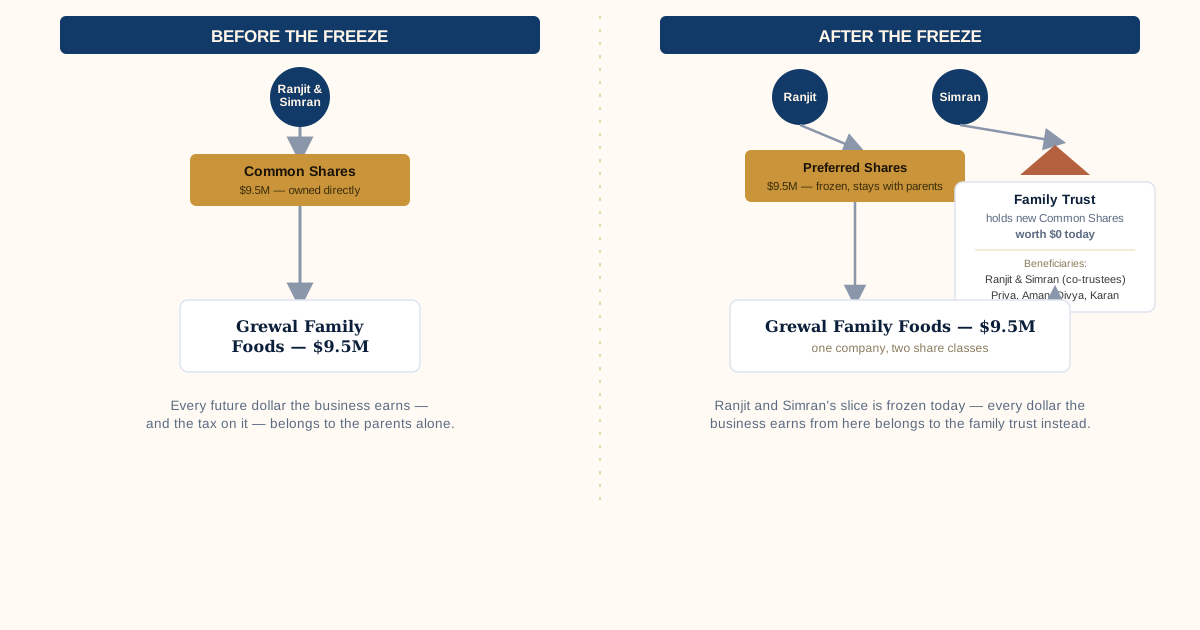
That’s essentially what option four does, and it’s the tool most families have never heard of, even though it’s often exactly what they need. The technical name is an estate freeze. Picture a photograph: the parents’ side of the business gets “frozen” at exactly what it’s worth today, while everything the business earns from this moment forward flows to the next generation instead — usually through a family trust.
Look at the diagram at the top of this article. Before the freeze, the parents hold the company’s shares directly, and every dollar the business earns from here on — along with the future tax bill on it — is theirs alone. After the freeze, they hold new shares locked at today’s value, while a family trust holds a second class of shares that starts at close to nothing today but is positioned to capture everything the business earns going forward. The parents can still sit as trustees, keeping real control while the ownership structure quietly does its job in the background.
Why bother? Because it turns an open-ended, unpredictable tax bill into a fixed, plannable number — and because it’s now easier to do inside a family than it used to be. Since 2021, Bill C-208 — and its 2024 refinements — rewrote the rules so a genuine sale from parent to child no longer gets penalized in the tax code compared to selling to a total stranger, as long as certain conditions are met. That single change quietly made this option realistic for a lot more families than it used to be.
What About The Kids Who Aren’t In The Business?
This is where a lot of otherwise-solid succession plans quietly fall apart. Divya and Karan grew up in the same family, but an estate freeze built purely around Priya and Aman’s involvement can leave them out of both the business and a fair share of the estate. Families who get this right usually lean on some combination of:
- Non-business assets — using investments, real estate, or other property to balance what the uninvolved children receive.
- Life insurance as an equalizer — a policy that pays a tax-free benefit to the children outside the business, without touching the company’s shares, cash flow, or control.
- Buyout arrangements — structured terms that let the operating children eventually buy out family trust interests over time.
- Voting versus non-voting shares — so economic value can be shared without handing operational control to people who aren’t running the company.
- Shareholder agreements — written rules for what happens on death, disability, disagreement, or a desire to exit.
- Trusts — holding and distributing value according to rules the family actually agreed to, rather than defaulting to intestacy or last-minute decisions.
- Communication and documentation — consistently the most-cited reason succession plans succeed or fail, and the cheapest one to get right.
Life insurance tends to stand out on that list for a practical reason: a death benefit is generally received tax-free, arrives at exactly the moment it’s needed, and can equalize an estate without forcing a sale of shares, a loan against the business, or an uncomfortable renegotiation between siblings at the worst possible time.
Who Actually Needs To Be In The Room
A freeze, a sale, or an equalization strategy this complex isn’t a one-advisor job. Families who navigate it well typically build a small team:
- An accountant, tax specialist, or Chartered Business Valuator — handling the valuation work behind a freeze, working with the family to turn goals into an actionable structure, and modelling the cash flow.
- An estate and business lawyer — drafting the new share structure, creating the family trust, updating everyone’s wills, and finalizing governance documents.
- A family facilitator — often someone with a Family Enterprise Advisor (FEA) designation through Family Enterprise Canada — running the harder conversations, interviewing family members individually, and reporting back honestly on where the real disagreements are.
- A financial advisor or financial planner — funding the plan.
That last role is easy to undervalue, but it’s usually the piece that determines whether the rest of the plan actually survives contact with real life. A financial advisor sitting on this kind of team typically brings a genuine understanding of the family’s wealth transfer goals, working knowledge of the financial and life insurance products that can fund a freeze or an equalization, an outside perspective that isn’t tied to running the business day to day, and the ability to ask the specific questions needed to size a life insurance solution correctly — one that supports the lawyer’s and accountant’s work instead of working against it, and that’s structured in a tax-efficient way from the start.
How The Grewals Resolved It
After several months of conversations with their advisory team, the Grewal family landed on a plan: an estate freeze, paired with an equalization strategy for the two children outside the business.
Priya was named the identified successor and future CEO, with a 12-to-18-month mentorship period alongside Ranjit before he steps back fully. Aman moved into the CFO role, formalizing the financial leadership he’d already been providing informally. Divya and Karan received no operational role and no voting shares — but were made beneficiaries of the family trust alongside their siblings, with a life insurance policy owned to fund an equalizing payment that reflects their share of the family’s overall estate, without touching the company itself.
Nobody got exactly the same thing. Everybody got something that reflected their actual role in the family and the business — which, in the end, is what “fair” turned out to mean.
What This Means For Your Family Business
If you own a family business, a few honest questions are worth sitting with: Does your family actually know what the plan is, or are you assuming everyone’s on the same page because no one’s brought it up? If something happened to you tomorrow, would the tax bill on your shares come due before anyone’s had time to plan for it? And the children who aren’t in the business — do they know where they stand, or are they finding out later, at the worst possible moment?
None of that requires a decision today. It usually just requires a conversation — with your accountant, your lawyer, and, when it comes to funding whatever the family ultimately decides, a financial advisor who’s done this kind of planning before.
Research & References
This article is for general education only and is not personalized financial, legal, tax, or investment advice. The Grewal family and Grewal Family Foods are an illustrative example, not an actual client. Estate freezes, share reorganizations, and intergenerational transfers involve complex tax and legal rules that depend on your specific corporate structure, family circumstances, and current legislation — always work with a qualified accountant, lawyer, and financial advisor before implementing any succession strategy.
Want to talk through this?
Start with a 30-minute session or protection review. No guaranteed outcomes are promised; the goal is to understand your situation and possible next steps.
Book a 30-Minute Session Related: Explore our financial planning services